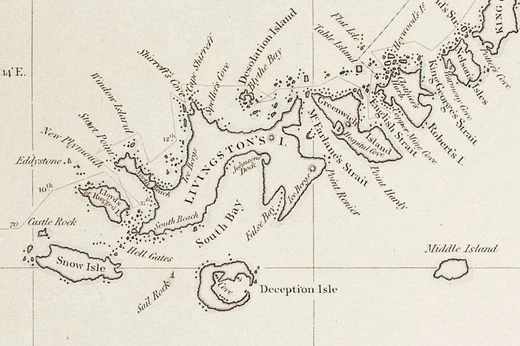
Phantom island
Phantom islands are map features later proven nonexistent.

A phantom island is a purported island that has appeared on maps but was later found not to exist. These islands usually originate from the reports of early sailors exploring new regions and are commonly the result of navigational errors, mistaken observations, unverified misinformation, or deliberate fabrication. Some have remained on maps for centuries before being 'un-discovered.' Unlike lost lands, which are claimed to have once existed but to have been swallowed by the sea or otherwise destroyed, a phantom island is one that is claimed to exist contemporaneously but later found not to have existed in the first place.
- field
- Cartography, maritime exploration
- known_for
- Appearing on historical maps despite never existing
- examples
- Dougherty Island, Emerald Island, Sandy Island
- first_recorded_sighting
- 4th century BC (Thule, reported by Pytheas)
- latest_map_appearance
- 1987 (Emerald Island in an American Express desk calendar)
Lore & Background
Notable phantom islands were discovered at various points, mostly during the 19th century. Dougherty Island was first spotted in 1841 by Captain Daniel Dougherty of the James Stewart, an Irish whaler, who reported discovering it at 59°20′S 120°20′W. He described it as 5–6 miles long with a high bluff to the northeast and covered in snow. Dougherty's discovery was confirmed by Captain Keates of the Louise in 1860 and by Captain Stannard of the Cingalese in 1886. The island continued to appear on maps as late as 1934. Emerald Island was first sighted by the British sealing ship Emerald, captained by William Elliot, in December 1821, and the name of the supposed island is derived from the name of this ship. It was presumed to be a small but high and mountainous island located at 57°30′S 162°12′E. No trace of the island was found by the 1840 United States Exploring Expedition, and a search by the Nimrod in 1909 turned up nothing. Nevertheless, it appeared on a map as late as 1987 in a desk calendar book published by American Express.
Reader's Guide
Phantom islands hold significance as enduring examples of how human error, miscommunication, and even deliberate fabrication have shaped geographic knowledge. They illustrate the challenges faced by early explorers who relied on imprecise navigation and secondhand reports. Some phantom islands, such as Sandy Island, persisted on maps into the early 21st century despite being 'undiscovered' in the 1970s, demonstrating how cartographic errors can become entrenched. Others, like Pepys Island, arose from the faulty positioning of actual islands, while the Baja California Peninsula and Banks Peninsula each appear as islands on some early maps but were later discovered to be attached to their mainlands. The phenomenon also includes cases where cartographers intentionally included invented features to catch plagiarists. In popular culture, Herman Melville references phantom reefs and shoals in Moby-Dick, noting that floating whale carcasses could be mistaken for hazards. The legacy of phantom islands reminds us that maps are not infallible records but products of their time, subject to the limitations and biases of their creators.
Did You Know?
- Dougherty Island was first spotted in 1841 by Captain Daniel Dougherty of the James Stewart, an Irish whaler, and continued to appear on maps as late as 1934.
- Emerald Island appeared on a map as late as 1987 in a desk calendar book published by American Express.
- Sandy Island continued to appear on maps and charts for decades; its non-existence was not confirmed until 2012.
- Isle Phelipeaux, an apparent duplication of Isle Royale in Lake Superior, served as a landmark for the border between the United States and the territory that would become Canada before surveyors determined it did not ex
More in Phantom Places & Discovery 1-24
Elsewhere in the Phantom Places & Discovery universe
Spotted an error? Know more?
This is a living reference — every entry is fact-audited, and reader corrections feed straight into our audit queue. Suggest an edit · See this site's audit record